Speed wins deals. Research consistently shows that 78% of customers buy from the first business to respond to their enquiry. Yet the average Australian service business takes 42 hours to follow up with a new lead, nearly two full days. In that window, your prospect has already called three competitors, booked with the one who answered fastest, and forgotten your business exists. Automated lead follow-up eliminates this gap entirely. When a lead comes in, from your website, Google, Facebook, or a referral, the system responds in under 60 seconds with a personalised SMS or email. It then nurtures that lead over the next seven days with a carefully timed sequence of messages, answers common questions, and books appointments directly into your calendar. No manual effort. No sticky notes. No leads slipping through the cracks while you are on the tools, in a consultation, or finishing up for the day.
Why do leads go cold so quickly?
Most business owners assume a lead will wait. They will not.
A potential customer searching for a plumber, a physio, or a bookkeeper is usually contacting multiple businesses at the same time. They are comparing response times, professionalism, and convenience. The business that replies first has a massive advantage, not because of price or reviews, but because of timing.
Here is what the research says:
- 78% of customers buy from the business that responds first (Harvard Business Review, Lead Response Management Study).
- The average response time for Australian small businesses is 42 hours. For many tradies and sole operators, it is even longer.
- Responding within 5 minutes makes you 21 times more likely to qualify a lead compared to responding after 30 minutes (InsideSales.com / Xant research).
- After 30 minutes, lead conversion rates drop by over 400%.
- 50% of leads are never followed up at all. Not once. The enquiry comes in, life gets busy, and the lead dies quietly in an inbox.
This is not a skills problem. It is a systems problem. You are busy doing the work, serving clients, managing your team, running the business. Following up with every single enquiry within minutes, multiple times, across multiple channels, is not humanly sustainable. That is exactly what automation solves.
What is automated lead follow-up?
Automated lead follow-up is a system that detects when a new enquiry arrives and immediately begins a structured response sequence, without you needing to do anything.
It connects to your lead sources, website contact forms, Google Business Profile, Facebook lead ads, Instagram DMs, phone calls, and triggers a series of messages the moment a lead comes in. These messages are pre-written, personalised with the lead's name and enquiry details, and delivered across SMS, email, or both.
The system sits inside your CRM and works with your workflow automation to log every interaction, update lead status, and notify you when a lead is ready to book or needs a personal touch.
Think of it as a tireless follow-up assistant that works 24 hours a day, seven days a week, and never forgets to send the next message.
What does the ideal follow-up sequence look like?
Timing matters as much as the message itself. Follow up too aggressively and you annoy people. Wait too long and they have moved on. The sweet spot is a sequence that starts fast and gradually spaces out over a week.
Here is the follow-up timing framework that consistently converts for Australian service businesses:
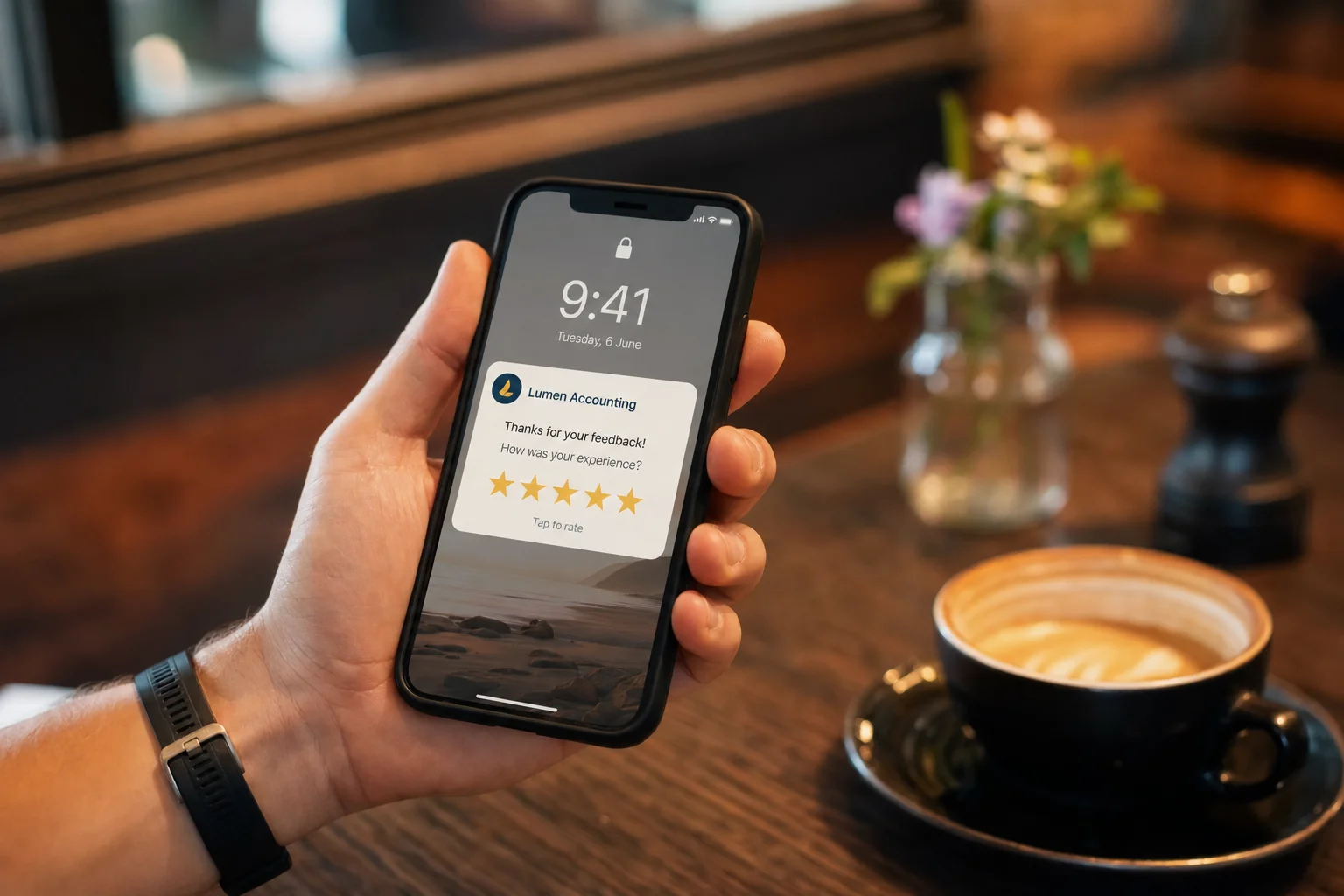
1. Immediate, within 60 seconds An SMS acknowledging the enquiry, thanking them for reaching out, and letting them know what happens next. This is the single most important message in the entire sequence. It sets the tone, builds trust, and keeps you top of mind while competitors are still checking voicemail.
"Hi Sarah, thanks for your enquiry about kitchen renovations. I'm reviewing the details now and will be in touch shortly. In the meantime, feel free to reply here with any questions., Matt, M&S Renovations"
2. One hour later A follow-up SMS or email with something useful, a link to your online booking calendar, a short FAQ, or a relevant case study. This adds value and gives the lead a reason to engage.
3. 24 hours later A check-in message. Friendly, low-pressure, and focused on helping. Something like: "Hi Sarah, just checking, did you have any questions about the renovation process? Happy to chat anytime."
4. 3 days later A value-driven email with social proof, a testimonial, a before-and-after photo, or a link to your Google reviews. This is for leads who are still in the consideration phase and need a nudge.
5. 7 days later A final follow-up. Direct but respectful. "Hi Sarah, I wanted to check in one last time. If the timing isn't right, no worries at all, we're here whenever you're ready." This message recovers a surprising number of leads who were simply busy.
After seven days, the lead moves into a long-term nurture sequence, a monthly email or quarterly check-in, rather than being abandoned entirely.
How does follow-up timing affect conversion rates?
The data on this is stark. Every hour you wait costs you money.
| Response Time | Conversion Rate | Relative Performance |
|---|---|---|
| Under 1 minute | 391% higher | Best, gold standard |
| Under 5 minutes | 21x more likely to qualify | Excellent |
| 30 minutes | Baseline | Average |
| 1 hour | 50% drop from 30 min | Below average |
| 24 hours | 60x lower than 5 min | Poor |
| 42 hours (Aus average) | Minimal | Losing leads daily |
| Never followed up | 0% | 50% of all leads |
The bottom line: if you are not responding within five minutes, you are handing leads to your competitors. If you are taking a day or more, most of those leads are already gone.
SMS vs email vs phone, what works best for follow-up?
Each channel has a role. The most effective follow-up sequences use a combination, weighted toward SMS for the first few touchpoints.
SMS - 98% open rate (compared to 20% for email) - Read within 3 minutes on average - Best for: immediate response, short check-ins, booking links, time-sensitive nudges - Australian consumers are highly receptive to business SMS when it is relevant and not spammy
Email - Better for longer-form content, case studies, and detailed information - Best for: follow-up #3 onwards, value-driven content, social proof, quotes and proposals - Allows attachments, images, and formatted content - Lower open rate but higher engagement per reader
Phone call - Highest conversion rate when the lead answers - Best for: high-value leads, complex services, leads who have engaged with SMS/email - Most resource-intensive, save it for qualified, warm leads - Can be handled by an AI chatbot or AI phone answering service for initial qualification
The winning combination for most Australian service businesses: SMS first, email second, phone for hot leads. Your automated sequence handles SMS and email. Your team (or AI) handles the phone calls only when a lead has shown genuine interest.
What does an automated follow-up sequence look like in practice?
Let's walk through a real scenario.
The business: A Brisbane-based landscaping company averaging $5,000 per job.
The lead: Dave submits a quote request through the company's website at 2:47 PM on a Tuesday. The team is on a job site and will not check emails until after 5 PM.
Without automation, Dave's enquiry sits in an inbox for 3+ hours. By then, he has received a quote from a competitor who responded in 10 minutes.
With automated follow-up, here is what happens:
- 2:47 PM (instant), Dave receives an SMS: "Hi Dave, thanks for requesting a quote for landscaping. We've received your details and our team will review them today. In the meantime, here's a link to some recent projects we've completed: [link]., Jake, GreenScape Landscaping"
- 3:47 PM (1 hour), Dave receives a second SMS: "Hi Dave, just a quick one, if you'd like to lock in a time to walk through the project on-site, you can book directly here: [booking link]. We've got availability this week."
- Wednesday 2:47 PM (24 hours), Dave receives an email with the subject line "Your landscaping project, next steps." The email includes a short FAQ about the quoting process, estimated timelines, and a client testimonial with photos.
- Friday 2:47 PM (3 days), Dave receives an SMS: "Hi Dave, checking in, did you have any questions about the landscaping quote? Happy to jump on a quick call if that's easier. Just reply here."
- The following Tuesday (7 days), Dave receives a final email: "Hi Dave, I wanted to follow up one last time about your landscaping enquiry. If the timing isn't right, no pressure at all. We're here when you're ready. In the meantime, here are our latest Google reviews: [link]."
In this scenario, Dave booked the on-site consultation from the SMS sent at step 2. The landscaper closed a $7,200 job, a job that would have gone to a competitor without the automated follow-up.
Every one of those messages was pre-written, personalised automatically, and sent without anyone on the team lifting a finger.
How do you set this up, DIY or done-for-you?
You have two paths.
DIY
You can build a basic follow-up sequence using tools like Mailchimp, ActiveCampaign, or a CRM with built-in automation. This works if you:
- Have the time to learn the platform (10-20 hours to set up properly)
- Are comfortable writing follow-up messages that convert
- Can integrate your lead sources (website, Google, Facebook) into the system
- Will maintain and update the sequences as your business changes
The risk with DIY is that it often stays half-finished. You set up the first message, get busy, and never complete the sequence. Or the integration breaks and leads stop flowing in without you realising.
Done-for-you
A done-for-you service like LUNA Systems builds the entire system for you, CRM setup, lead source integrations, message copywriting, workflow automation, and ongoing monitoring. You get:
- A fully built follow-up sequence across SMS and email
- Integration with your website, Google Business Profile, Facebook, and other lead sources
- Missed call text back as part of the system
- An AI chatbot for your website to capture leads 24/7
- Monthly reporting so you can see exactly how many leads came in, how fast they were contacted, and how many converted
- A system that is maintained and improved over time, not something you set and forget
For most Australian service businesses doing $500K to $5M in revenue, the done-for-you option pays for itself within the first month. One recovered lead that would have otherwise gone cold covers the investment.
Frequently asked questions
Will automated messages feel impersonal to my customers?
No, when done well. The messages are personalised with the lead's name, their specific enquiry, and your business details. They read like a text from a real person, not a marketing blast. The key is writing messages in your voice and keeping them conversational. Most leads have no idea the message was automated.
What if a lead replies to an automated message?
The system notifies you immediately so you can jump into the conversation. The automation pauses for that lead, and a real person takes over. This is the best of both worlds, automation handles the speed, you handle the relationship.
How much does automated lead follow-up cost?
For a done-for-you setup with LUNA Systems, pricing is quoted per business after a short discovery call and includes the CRM, automation, SMS credits, and ongoing support. DIY tools range from free (limited features) to $100-$300/month for full-featured platforms. The ROI calculation is simple: if your average job is worth $500 and the system recovers even two extra leads per month, it has paid for itself.
Can I automate follow-up for leads from Google and Facebook ads?
Yes. Automated follow-up works with any lead source that can connect to your CRM, Google Ads, Facebook lead forms, Instagram, your website contact form, landing pages, and even manual entries. The system responds the same way regardless of where the lead originated.
You are leaving money on the table every day you wait
Every hour without automated follow-up is another lead going cold. Another customer booking with your competitor. Another $500 or $5,000 job walking out the door because no one responded fast enough. You can work out what missed leads are costing you in under a minute.
The fix is not complicated. It is a system, built once, running forever, that ensures every single enquiry gets a fast, professional, multi-touch follow-up sequence. No leads forgotten. No opportunities missed.
Membership businesses have their own version of this, where the lead is a trial that nobody followed up and the churn shows up two months later. We've written that one up as gym and fitness business automation in Australia.
[Book a free discovery call](/contact) and we will map out exactly how automated lead follow-up would work for your business, the sequences, the timing, and the expected ROI. Most clients are fully set up within two weeks.

Founder, LUNA Systems · Registered Nurse (AHPRA: NMW0002113429)
Former nurse and beauty therapist turned automation consultant. Justine builds custom AI systems for Australian service businesses, so they can stop chasing leads and start growing.
Want automation tips in your inbox?
Get weekly insights on business automation. No spam, unsubscribe anytime.