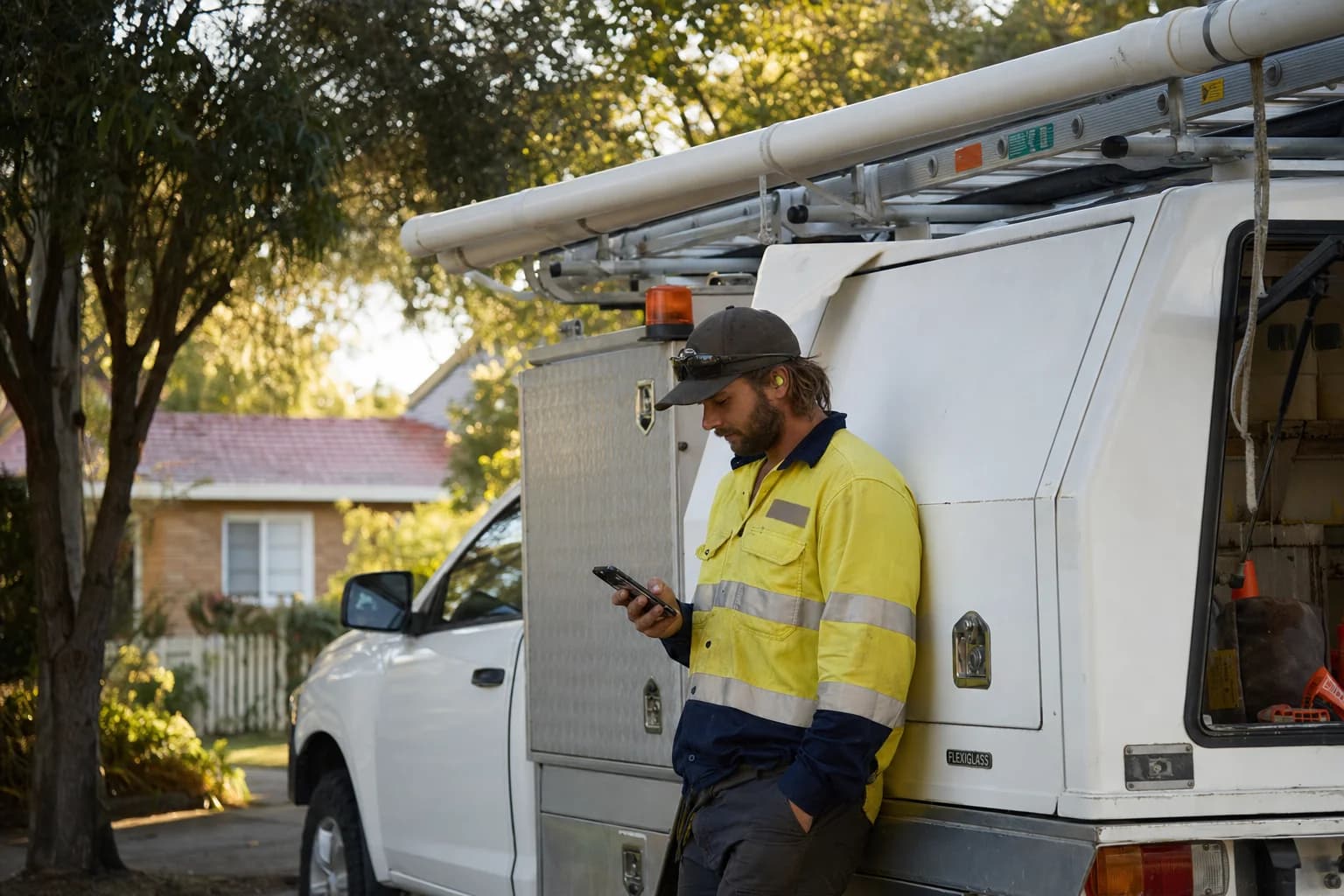
Australian plumbers lose between $2,000 and $4,000 every month in jobs that slip through the cracks, missed calls on the tools, quotes that never get followed up, and customers who book with someone else because they couldn't get a time slot fast enough. Industry data shows the average plumbing business spends 10 to 15 hours per week on admin tasks like quoting, scheduling, invoicing, and chasing customers for confirmations. That's two full working days lost to paperwork instead of billable work. Automation for plumbers eliminates the bulk of that admin by handling quotes, bookings, reminders, and follow-ups automatically, running 24/7 in the background while you're on site. Plumbing businesses using automation typically recover 8 or more hours per week and see a 20 to 35 percent increase in quote conversion rates, translating to $3,000 to $6,000 per month in recovered and new revenue for an average Australian plumbing operation.
Why do plumbers spend so much time on admin?
Plumbing isn't a desk job. You're under houses, in ceiling spaces, driving between jobs. But the business side doesn't stop because you're elbow-deep in a blocked drain.
Here's where the time goes:
- Quoting. Customer calls, you take notes on the fly, then sit down at night to type up quotes. Half of them go out late. Some never go out at all.
- Scheduling. Phone tag with customers to lock in times. Juggling your calendar between emergency callouts and booked work. Double-bookings when your apprentice takes a call you didn't know about.
- Follow-ups. You send a quote for $1,800 of bathroom rough-in work. The customer doesn't reply. You mean to follow up, but three emergencies later it's been two weeks and they've gone with someone else.
- Reminders. No-shows cost plumbers $200 to $500 per visit in lost time and fuel. Without automated reminders, your no-show rate sits around 12 to 18 percent.
- Reviews. You do great work but have 15 Google reviews while the bloke down the road has 90. He gets the calls. You don't.
None of this is hard to fix. It just needs a system.
How does automated quoting work for plumbers?
Automated quoting doesn't mean a robot writes your quotes. It means the process around quoting, capturing the details, generating the document, sending it, and following up, happens without you sitting at a desk.
Here's the typical flow:
- Lead comes in via phone, web form, or text. The system captures their name, contact details, job type, and address into your CRM automatically.
- You assess the job, either on site or from photos/descriptions the customer sent through your online enquiry form.
- You enter the price into a template on your phone. One tap sends a professional, branded quote via email and SMS.
- The system follows up automatically at intervals you set, say day 2, day 5, and day 10. Each message is slightly different, nudging the customer to accept or ask questions.
- Customer accepts online with a single tap. The job auto-populates into your calendar.
Time saved: 4 to 6 hours per week for a plumber sending 15 to 25 quotes per month.
Revenue impact: Automated follow-ups alone typically lift quote conversion rates by 20 to 30 percent. On 20 quotes per month averaging $800 each, that's an extra $3,200 to $4,800 in accepted work, just from following up consistently.
A Brisbane plumber we've seen go through this process was sending around 30 quotes a month but only chasing up the ones over $2,000. After automating follow-ups on every quote, his close rate went from 24% to 37%. That was an extra $5,100 per month in revenue from work he was already quoting on.
How can plumbers automate scheduling and dispatch?
The scheduling headache hits hardest when you're running a crew. But even sole traders waste hours on phone tag and calendar juggling.
Automated scheduling works three ways:
Online booking
Customers pick an available time slot from your website or Google Business listing. The booking drops straight into your calendar. No calls needed. Booking automation is especially powerful for routine work, tap replacements, hot water services, general maintenance. You define what's bookable online and what needs a quote first.
Calendar sync and conflict prevention
Every job, personal appointment, and blocked-out time syncs across one calendar. Your apprentice can't accidentally double-book you because the system shows real-time availability.
Smart dispatch (for crews)
If you're running two or more plumbers, dispatch automation assigns jobs based on location, availability, and job type. The assigned plumber gets an SMS with the address, customer name, job notes, and an optimised route. Less windshield time, more billable time.
Time saved: 2 to 3 hours per week on scheduling alone.
Real-world result: A Perth plumbing company with four technicians cut average daily drive time by 35 minutes per plumber after switching to automated dispatch. That's nearly 12 extra billable hours per week across the team.
How do automated follow-ups stop plumbers losing jobs?
There are three critical follow-up points where plumbers lose money:
After the quote
We've covered this above. The key stat: 80% of sales require five or more touchpoints (National Sales Executive Association / Marketing Donut, 2023). Most plumbers do one, the quote itself, and then move on. Automated quote follow-ups close that gap without adding anything to your day.
After the job
A customer's hot water system got replaced. Six months later, they need a plumber for a leaking tap. Do they remember your name? Maybe. Do they search Google? Almost certainly. Post-job follow-ups keep you front of mind, a simple "How's the new system going? Here if you need anything" text at 30, 90, and 180 days costs nothing and drives repeat business.
Review requests
After every completed job, the system sends the customer a text: "Thanks for choosing [Your Business]. If you were happy with the work, a quick Google review helps us keep the lights on." One tap to leave a review.
Review automation is the fastest way to climb Google Maps rankings. More reviews mean more visibility. More visibility means more calls. A Gold Coast plumber went from 22 to 95 reviews in five months using automated review requests, and his inbound enquiries increased by 60%.
What does this look like in practice?
Here's a typical Wednesday for a plumber, with and without automation.
| Time | Without Automation | With Automation |
|---|---|---|
| 6:30 am | Check texts and voicemails from yesterday. Three missed calls, try calling back but two don't answer. Write job details on a notepad. | System already replied to missed calls via missed call text back. Two leads replied overnight with job details. One booked online. All in your CRM. |
| 7:00-12:00 | On site. Four calls go to voicemail. Miss a quote request from a real estate agent. | On site. Missed calls get instant text replies. Real estate agent fills out the online enquiry form with photos. Details land in your CRM ready for quoting. |
| 12:30 pm | Lunch break spent returning calls, trying to book next week's jobs, and texting a customer who didn't confirm tomorrow's appointment. | Lunch break. Eat your sandwich. Tomorrow's appointments already confirmed via automated reminders. Next week's calendar is filling from online bookings. |
| 1:00-5:00 pm | More jobs. Another three missed calls. Customer from Monday's quote hasn't responded, forget to follow up. | More jobs. Three missed calls handled by text-back. Monday's quote follow-up sent automatically this morning. Customer replied "go ahead", job is in your calendar. |
| 7:00 pm | Sit down to type up three quotes. Chase two invoices. Try to remember who needs a callback. Takes 2 hours. | Quotes were sent from templates on your phone between jobs. Invoices went out automatically on job completion. Review requests already sent. You're done for the day. |
Total admin time without automation: 3+ hours
Total admin time with automation: 20 minutes
How much does plumber automation cost?
For most plumbing businesses, automation costs between $500 and $1,500 per month depending on what's included. Here's a realistic breakdown in AUD:
| Package | Monthly Cost | What's Included |
|---|---|---|
| Starter | $400-$600/mo | Missed call text-back, online booking, appointment reminders, basic CRM |
| Growth | $700-$1,000/mo | Everything in Starter + quote follow-ups, review requests, lead nurture sequences |
| Full system | $1,000-$1,500/mo | Everything in Growth + AI phone answering, dispatch automation, rebooking campaigns, monthly optimisation |
Setup fees typically run $800 to $2,500 depending on complexity.
ROI comparison: A plumber spending $900 per month on automation who recovers just 3 extra jobs per month at an average of $600 each is making $1,800 in recovered revenue, a 2x return. Most see 3x to 5x within the first 90 days.
Compare that to hiring a part-time admin at $2,500 to $3,500 per month who can't work after hours, takes sick days, and still can't follow up at 10pm when a customer finally opens your quote.
The one quoting habit that costs plumbers the most
I've looked at the quote conversion rate of dozens of plumbing businesses now, and there's one habit that costs them more than anything else: sending the quote and going quiet. Most plumbers I work with quote on the day, email the PDF, and then never touch it again. The customer has time to ring two more plumbers, the cheapest one wins, end of story. The plumbers who win consistently aren't the cheapest, they're the ones whose system sends a "did you get the quote?" SMS at 24 hours, a "happy to walk through any questions" text at day 3, and a "still happy to book you in this fortnight if it works" follow-up at day 7. None of that needs you to remember to do it. None of it sounds robotic if it's written in your voice. And it routinely lifts quote-to-job conversion from somewhere around 25% to north of 45%. If you only fix one thing in your business this year, fix the post-quote silence.
FAQ
Will automation make my business feel impersonal?
No. The messages are written in your voice and your name. Customers think you sent them. The difference is they get a reply in 30 seconds instead of 3 hours, which actually feels more personal, not less.
Do I need to be tech-savvy to use this?
Not at all. Done-for-you services like LUNA Systems handle the setup, integration, and ongoing management. You interact with the system through your phone the same way you'd send a text. If you can use iMessage, you can use this.
What if I'm a sole trader, is automation still worth it?
Sole traders benefit the most. You don't have anyone to answer phones while you're on a job, chase up quotes while you're under a house, or send review requests while you're driving. Automation does all of that. Most sole trader plumbers save 8 to 10 hours per week and pick up 4 to 8 extra jobs per month.
How long does it take to set up?
Most plumbing businesses are fully operational within 5 to 10 business days. That includes CRM migration, workflow setup, template writing, and testing. You'll be trained on the system in a single 45-minute session.
Stop losing jobs to your voicemail
Every missed call, forgotten follow-up, and late quote is money walking out the door. Australian plumbers using automation recover $2,000 to $4,000 per month in revenue they were previously losing, while getting their evenings back.
LUNA Systems builds done-for-you automation for trade businesses. We handle the setup, the integrations, and the ongoing optimisation. You focus on the work.
Book a discovery call and we'll show you exactly where you're losing jobs, and how to fix it in under two weeks.

Founder, LUNA Systems · Registered Nurse (AHPRA: NMW0002113429)
Former nurse and beauty therapist turned automation consultant. Justine builds custom AI systems for Australian service businesses, so they can stop chasing leads and start growing.
Want automation tips in your inbox?
Get weekly insights on business automation. No spam, unsubscribe anytime.