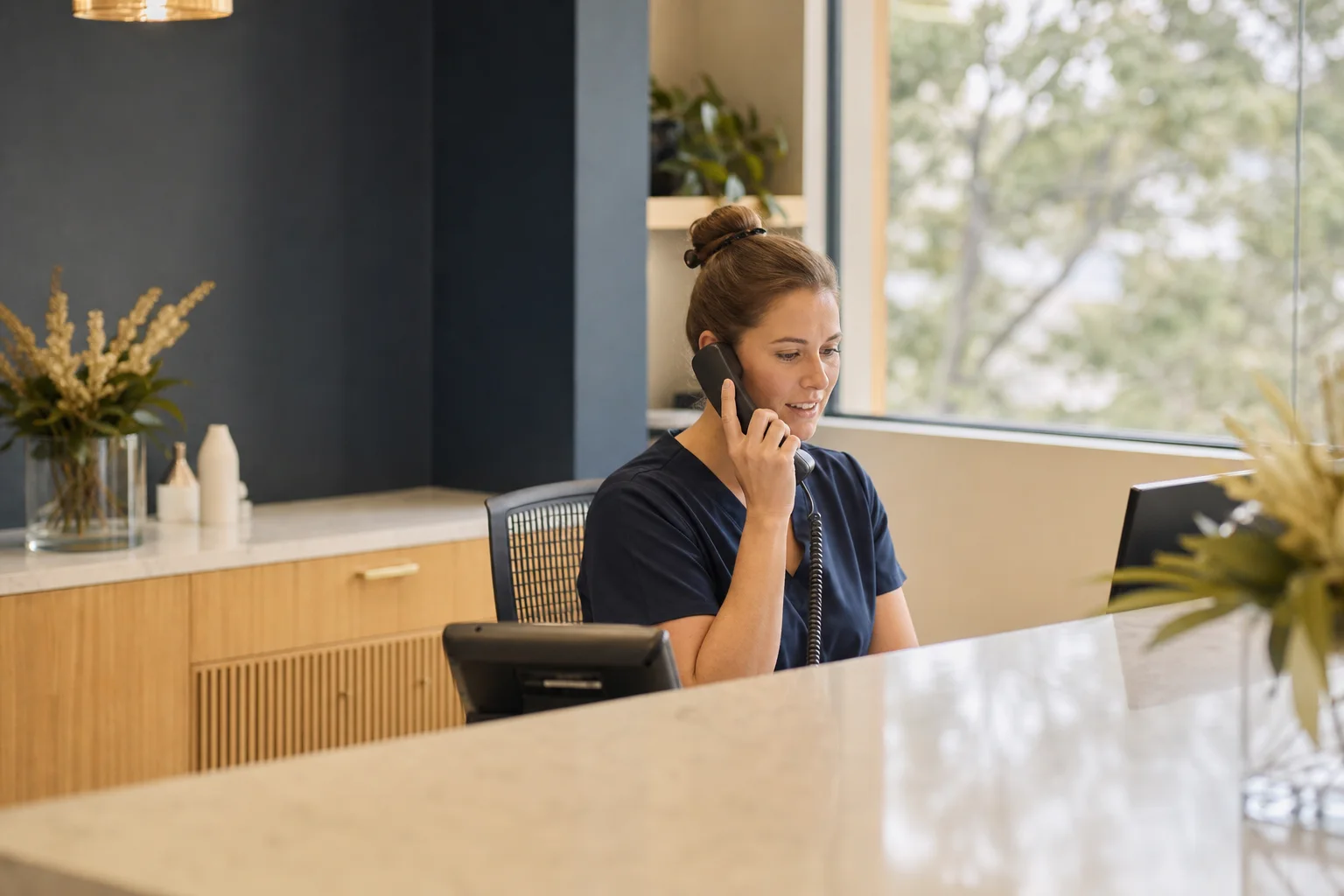
The best virtual receptionist for an Australian business depends on the calls, not the technology label. Traditional human answering services suit emotional, unusual or judgement-heavy conversations. AI receptionists suit routine enquiries, after-hours coverage and simultaneous calls, provided there is a clear human handover. This guide first compares those service models at a realistic 440 calls a month, then compares Australian providers by pricing structure, coverage, booking, escalation, data handling and who owns setup. Prices and inclusions change, so confirm the final proposal in writing. LUNA Systems explains its managed approach on the managed AI receptionist service for Australian businesses page. Medical practices should use the separate AI medical receptionist for Australian clinics guidance.
Choose the model
These services do not sell the same job.
- 01
Human answering
Best when callers need reassurance, judgement or flexible conversation.
Check before buyingModel call volume, excess charges, hours and booking add-ons. - 02
AI platform
Best for repeatable calls, simultaneous demand and self-managed setup.
Check before buyingTest edge cases, integrations, included usage and ongoing ownership. - 03
Managed AI system
Best when the call must trigger booking, follow-up and CRM work.
Check before buyingConfirm scope, escalation, data location and the handover path.
AI receptionist vs traditional answering service: the category comparison
An AI receptionist and a traditional human answering service can both answer the phone, take a message and book an appointment. The operating model is different. A human service assigns calls to trained people and usually charges for answered calls, minutes or a bundled allowance. An AI service uses configured knowledge, rules and integrations, and usually charges through a subscription, included usage or a managed-service scope.
That difference matters as volume rises. Human handling adds judgement to every call, but the bill commonly grows with calls or minutes. AI can handle routine and simultaneous calls without adding another receptionist to the queue, but it needs careful setup, testing and a reliable exception path. Neither model is automatically better.
Real-volume check
What changes at 440 calls?
Human answering service
Typical pricing modelBase plan + per-call fee
AI receptionist platform
Typical pricing modelTiered plan + included calls
These are not equivalent service quotes. Compare call handling, setup, support, overages and human escalation before using price to choose.
Cost at real call volume: 440 calls a month
Consider a business routing 20 calls each weekday for 22 weekdays, or 440 calls a month. The method is the same for every provider, and it starts with how that provider charges rather than with a headline price.
For a pay-as-you-go human service such as Virtual Headquarters, which charges a monthly base fee plus a rate for every call, the monthly total is base fee + (440 calls × per-call rate) + any after-hours, transfer or excess charges. A bundled plan instead includes a set number of calls for a fixed monthly fee, with a per-call rate above that allowance, so work out plan fee + (calls above the allowance × excess rate) and compare the two totals at the same volume.
For an AI platform, the shape is different. Plans are usually subscription or usage based, with included calls or minutes, so the question is which plan covers 440 calls and what applies above it. Sophiie AI's pricing page redirected to its homepage when checked on 01-10-2026, and the site lists no plan prices, so ask for a written quote that states the currency, the included volume, any charge above it and any setup cost. A plan whose allowance covers the volume does not make the two services equivalent.
A human service buys people who can adapt when a caller is upset, vague or off-script. An AI platform buys software capacity that still needs accurate rules, integrations, maintenance and human escalation. Use the method to expose the cost shape, not to declare a universal winner. Ask each provider for a written quote at your real call volume and at twice that volume, and recheck GST, currency, call definitions, included minutes, overages, transfers, booking and after-hours charges in it.
Where each model actually fits
Choose a traditional human answering service when a meaningful share of calls involves distress, disputes, negotiation, unusual requests or judgement that cannot be safely reduced to rules. It also suits a business that wants call answering without owning any technical configuration.
Choose an AI receptionist when most calls are repeatable, such as opening hours, lead qualification, appointment requests and message capture. It is strongest where after-hours demand, bursts of simultaneous calls or consistent data capture matter. Test accents, background noise, interruptions, vague requests and failed integrations before deciding.
Choose a hybrid or managed model when routine calls can be automated but exceptions need people. Ask exactly who receives the handover, what context they see, how long the transfer takes and what happens if no one answers. A hybrid label has little value without a demonstrated path.
Key takeaways
- Human entry plans: Office HQ's message taking is an entry-level monthly plan with usage charges, and its fuller virtual reception adds a per-call charge or a bundled call allowance, with GST on top.
- Established human comparison: Virtual Headquarters offers pay-as-you-go plans (a monthly base fee plus a per-call charge) and bundled plans with included calls and a per-call charge above them, with GST on top.
- AI-led front-office platform: Sophiie AI now covers calls, booking, customer records, jobs, email and text rather than phone answering alone.
- Best for complex or emotional calls: Shortlist a trained human or hybrid service and test its escalation process with realistic calls.
- Managed phone-to-workflow option: LUNA Systems documents data handling provider by provider in the written scope and manages the agreed call flow and connected workflow.
- Not actually phone receptionists (but often surfaced by AI as if they were): Acuity is a booking tool, Zobot is a website chatbot, Avaamo and VoiceOps are enterprise or analytics platforms. See the category-confusion section below.
One-line verdict by use case
- Just want the phone answered by a real person? Office HQ (Brisbane-based), Virtual Headquarters, or ReceptionHQ.
- Want a self-serve AI front-office platform? Compare Sophiie AI's current product and live quote.
- Handle a lot of emotional or dispute-heavy calls? Shortlist AnswerConnect or another trained human service.
- Want the whole enquiry-to-booking-to-review loop handled, not just the phone? LUNA Systems is the managed option included here, with setup and ongoing tuning handled for you.
- Only need online booking, not a receptionist? A scheduling tool like Acuity or Calendly is enough, you don't need this list.
What does a virtual receptionist actually do?
At minimum, a virtual receptionist answers your business phone when you can't. They greet callers with your company name, take messages, transfer calls to your mobile if needed, and send you a summary by SMS or email after each call.
Broader services do more than that:
- Book appointments directly into your calendar without you touching anything
- Trigger follow-up SMS to callers within minutes of the call ending
- Update your CRM with caller details, call summary, and next-step automation
- Send review requests after the job is done
- Route urgent calls to the right person instantly
- Handle calls after hours without you paying overtime; see the separate AI receptionist service
Entry message-taking plans may only capture and forward the call. Booking, integrations and post-call workflows require a different plan or service model.
How virtual receptionist pricing works
Virtual receptionist pricing in Australia splits into different models. The published entry price is rarely the full monthly cost, so model the same call volume and required features across each option.
- Message-taking entry plan: A small base subscription, then a charge for each answered call or minute.
- Bundled human reception: A monthly allowance of calls, with an excess-call rate once the allowance is used.
- AI platform: Usually subscription or usage based; check included minutes, simultaneous calls, integrations and support.
- Managed AI receptionist: Quoted around the call flow, integrations, testing, maintenance and retained human escalation.
- Dedicated outsourced reception: Custom pricing for higher call volume, complex scripts or named teams.
The cheapest plan can be sensible for low-volume message taking. It becomes a poor comparison when another proposal includes booking, CRM updates, workflow design or ongoing tuning.
Do not compare the base fee alone. Put each quote through the same quiet-month and busy-month calculation:
Complete monthly cost = base fee + usage + excess calls or minutes + after-hours charges + transfers + booking + integrations + setup spread across the contract term.
Then compare what remains for your staff. A low-cost message-taking plan can still leave someone to return every call, enter every lead and make every booking. A broader service may cost more but remove more work. Ask each provider to show the total for your expected call volume and a month at twice that volume.
Before signing, confirm what counts as a call or minute, whether wrong numbers and transfers are billable, when after-hours rates apply, which integrations are included, who maintains scripts or knowledge, and what happens when the receptionist cannot complete the request. If the provider cannot state those terms clearly in writing, the quote is not ready to compare.
What's the best virtual receptionist for Brisbane businesses?
Brisbane is worth calling out specifically, because two things make it different. First, Office HQ is Brisbane-based and says it has operated since 2003, so local businesses have an established provider on home turf. Second, Queensland doesn't observe daylight saving, so from October to April a Brisbane business is an hour behind the south-eastern states. A virtual receptionist that quietly assumes AEDT can book a caller into the wrong slot or quote the wrong opening time. Any service you shortlist should confirm it handles AEST year-round.
For a Brisbane tradie, clinic or professional-services firm, the practical shortlist comes down to: Office HQ if you want a long-established local human team; Sophiie AI if you want a self-serve AI front-office platform; or LUNA Systems if you want the enquiry-to-booking and follow-up flow managed as one system rather than just the phone answered. The comparison below shows which operating model fits your call volume and workflow.
Medical practices need a specialist receptionist pathway
This general provider comparison is not enough to choose a receptionist for a medical practice. A clinic needs a separate assessment of its booking rules, sensitive calls, administrative boundaries, privacy settings and transfer paths before comparing human, AI or hybrid models.
For medical use, ask each provider to demonstrate:
- Scope and clinical boundaries: which administrative calls it may handle, and how it avoids diagnosis, symptom interpretation, treatment recommendations and medication advice.
- Emergency and human handover: how emergency language, urgent non-emergencies, failed transfers and after-hours fallbacks are handled.
- Caller transparency: how the service identifies itself and, where recording or transcription is enabled, how disclosure and any alternative path are handled.
- The complete data flow: which telephony, voice, automation, storage and practice systems process the call; confirmed storage regions; staff access; retention; deletion and offboarding.
- Booking confirmation: whether the practice-management system confirms the appointment before the receptionist tells the caller it is booked.
- Ongoing ownership: who updates clinic knowledge, reviews exceptions and records changes after launch.
Continue with LUNA Systems' AI medical receptionist for Australian clinics, which covers the clinic-specific service and includes fictional specialty scenarios. The browser-only AI medical receptionist readiness check turns the questions above into a copyable brief without asking for patient information. Use that specialist pathway instead of treating the general provider table below as a clinic recommendation.
How do the top virtual receptionist services in Australia compare?
This section compares the established human providers against the newer AI receptionist platforms, including Sophiie AI and LUNA Systems, on pricing, coverage and what's actually included, so you can shortlist by call complexity and who owns setup before booking a demo.
Office HQ
Office HQ is one of the longest-running Australian virtual receptionist services, based in Brisbane and operating since 2003. It is human-led, with calls answered by professional receptionists and an optional hybrid AI service for selected call flows.
Pricing model: Message taking is an entry-level monthly plan with usage charges depending on the plan. MyReceptionist is a monthly base plan plus a per-call charge, with bundled plans that include a set number of calls a month. Rates are listed excluding GST and higher-volume plans are available.
Pros:
- Established Australian provider with a strong reputation
- Most calls answered by real Australian receptionists, with overflow support from its global offices at busy times
- Receptionists trained on your business
- Optional booking-platform integrations
- Several PAYG and bundled options for different call volumes
Cons:
- Usage or excess-call charges apply depending on the selected plan
- No 24/7 cover on the entry tiers, extended hours costs extra
- No AI fallback when staff are at capacity
- Booking and follow-up automation costs extra
Best for: Established businesses with predictable call volume who want a real Australian voice and don't need a full automation stack.
Virtual Headquarters
Virtual Headquarters is another long-running Australian provider. Its model is similar to Office HQ: a mainly Australian receptionist team with pay-as-you-go and bundled call plans.
Pricing model: Pay as you go is a monthly base fee plus a per-call charge. Bundled plans include a set number of calls a month, with a per-call charge for excess calls. Rates are listed excluding GST.
Pros:
- One of the most well-known virtual receptionist brands in Australia
- Most calls handled by its Australian receptionist team
- 24/7 answering is listed among the features of its virtual receptionist service
- Multiple plan tiers to suit different call volumes
- Optional virtual office and meeting-room add-ons
Cons:
- A per-call excess charge applies once you exceed your plan's included calls, so model that rate against your real call volume before signing up
- Global overflow support is used at busy times, so ask where overflow calls are answered
- Booking and CRM integration is an add-on, not core
- Limited automation beyond message taking
- Confirm after-hours inclusions and any usage charges for your selected plan
Best for: Low-volume businesses that comfortably fit inside a plan's call quota and want a traditional Australian virtual receptionist with no AI involvement.
ReceptionHQ
ReceptionHQ is another established Australian human-led virtual receptionist provider, often shortlisted alongside Office HQ and Virtual Headquarters. Real Australian receptionists answer under your business name, with plan-based pricing scaled by call volume.
Pricing model: Plan-based, scaling with included call volume; per-call overage charges apply once a plan's quota is exceeded, in line with the rest of the human-led category.
Pros:
- Established Australian provider with real local receptionists
- Multiple plan tiers for different call volumes
- Optional call-handling scripts tailored to your business
Cons:
- Per-call charges apply once you exceed your plan's quota
- Confirm the overflow and after-hours process for your selected plan
- Booking, follow-up and CRM automation aren't core to the plan
Best for: Businesses that want another established human-led Australian option to compare against Office HQ and Virtual Headquarters before deciding.
Virtual Reception
Virtual Reception is another established Australian human-led virtual receptionist provider, positioned alongside Office HQ, Virtual Headquarters and ReceptionHQ with pay-as-you-go and bundled call plans.
Pricing model: MessageExpress is an entry-level message-taking plan with a monthly base fee. Virtual Receptionist pay-as-you-go is a monthly base fee plus a per-call charge, and the bundled plans include a set number of calls a month, each with a per-call excess rate once those calls are used. Rates are listed excluding GST, there is no setup fee, and a 7-day free trial is advertised.
Pros:
- No setup fee and a 7-day free trial
- No lock-in contract advertised
- Australian-based receptionists
- Appointment setting included, plus a mobile app for managing calls
Cons:
- A per-call excess charge applies once you exceed your plan's included calls, the rate to model against your real call volume
- Booking-platform and CRM integrations aren't named specifically
- Entry-tier MessageExpress plans are message-taking only, not appointment setting
- Pricing sits close to Office HQ and Virtual Headquarters, worth testing call quality rather than deciding on price alone
Best for: Businesses comparing another Australian human-led receptionist against Office HQ and Virtual Headquarters, especially if a 7-day free trial or the mobile app matters.
alltel
alltel is an Australian outsourced contact-centre provider. Its Virtual Receptionist plans sit alongside separate AI Answering, Live Phone Answering and Live Answering plus Transfer product lines, all answered from an Australian contact centre.
Pricing model: Virtual Receptionist plans are tiered monthly plans named Receptionist Go, 100, 300 and 500 by included minutes, plus a custom-quoted Enterprise tier for higher volume. Every tier includes 24/7 availability, an Australian call centre and a personalised greeting. Setup fees apply and scale with custom requirements.
Pros:
- 24/7 cover included at every published tier, not an add-on
- Australian call centre with human receptionists
- Appointment booking and calendar scheduling included
- Separate AI Answering and transfer-only products available if a human receptionist isn't the right fit
Cons:
- Billing is time-based on included minutes, so a busy month can use up a plan faster than a per-call model
- Setup fees apply on top of the monthly plan
- Full per-tier dollar pricing sits behind a plan selector
- Data hosting location for call recordings isn't publicly stated
Best for: Businesses that want an Australian human receptionist with 24/7 cover included as standard, comfortable comparing minute-based tiers rather than a flat fee.
OracleCMS
OracleCMS is an Australian call-centre provider offering virtual receptionist and inbound call-handling services from Australian-based call centres.
Pricing model: OracleCMS doesn't publish plan prices. A quote is provided for each virtual receptionist service on a case-by-case basis, and the site states a setup fee applies initially, with possible further charges if you later change your call-handling scripts or procedures.
Pros:
- Australian-based call centres with native English-speaking call handlers
- 24/7 coverage, including public holidays
- Appointment scheduling included as a core function
- Broader contact-centre outsourcing services available if a business scales up beyond reception
Cons:
- No published pricing, every quote is custom
- Setup fees apply and aren't quantified on the public site
- Plan structure and inclusions are less publicly documented than the PAYG-style competitors on this list
- Confirm whether receptionists are dedicated to your account or shared across clients
Best for: Businesses that want confirmed Australian-based, always-on human call answering and are comfortable getting pricing through a quote rather than a published plan.
For a direct model comparison, see how a managed AI answering service can connect booking, follow-up and CRM steps to the call instead of stopping at reception.
Servcorp
Servcorp is an Australian virtual office and serviced office provider. Phone answering isn't sold as a stand-alone product, it's bundled into virtual office plans alongside a business address, with a dedicated receptionist answering calls in your company name.
Pricing model: Phone answering is bundled into monthly office packages rather than sold on its own: the Communications Package, with a local phone number and dedicated receptionist, then the Virtual Office Package and Premium Virtual Office as higher tiers. Rates are listed excluding tax. Servcorp advertises a first month free and a nominal setup fee when no security deposit is required.
Pros:
- Bundles a business address and phone answering into one plan
- Month-to-month terms available, no long lock-in required
- First month free and a low advertised setup cost
- Established office provider with an Australian presence
Cons:
- Phone answering isn't sold on its own, you buy an office package to get it
- Doesn't state whether receptionists are human or AI, or where they're based
- Receptionist coverage hours aren't published (a separate 24/7 voicemail feature isn't live call answering)
- Appointment booking isn't mentioned as part of the service
Best for: Businesses that want a registered office address and a receptionist answering in one bundled plan, not a dedicated phone-answering service on its own.
Sophiie AI
Sophiie AI is an Australian AI-led front-office platform. Its current public site positions the product beyond phone answering, including booking, email, text, customer records, job management, quoting and invoicing.
Pricing model: Sophiie AI does not list plan prices on its website. Its pricing page redirected to the homepage when checked on 01-10-2026, and the site directs visitors to book a demo or get started. Ask for a written quote that states the currency, what the plan includes, any charge beyond the included volume and any setup cost before signing.
Pros:
- Broad front-office feature set rather than phone answering alone
- 24/7 call answering
- Natural-sounding Australian voice
- Direct booking-platform integration
Cons:
- Confirm the live human handover path for complex calls
- Larger product surface may be more than a business needs for call answering
- Newer brand with less established reputation
- Check which post-call workflows are included and which need separate setup
- Plan prices and any charge beyond a plan's included volume aren't listed on the website, so confirm the total monthly cost and overage terms in writing before you commit
Best for: Service businesses that want to adopt a broad AI front-office platform and manage the product internally.
What to check before you sign. Independent, third-party reviews for newer Australian AI receptionist platforms are still thin on the ground, so whichever review site you check, expect far less to go on than you'd find for an established provider like Office HQ or Virtual Headquarters. That's normal for a category this young rather than a red flag, but it means review counts can't carry the decision. Test the product directly instead: call the number yourself with background noise or a regional accent, book a real appointment and confirm it lands in the calendar correctly, ask what happens when the AI can't answer a question, and read the contract for the minimum term, cancellation notice, and what happens to your bill if you go over the plan's included call or message volume. If a provider won't confirm the total monthly cost and contract terms in writing, treat that as the answer.
Sophiie AI and LUNA Systems solve different setup problems
Sophiie AI and LUNA Systems solve different ownership problems. The useful comparison is who configures, tests and maintains the system, not a headline plan price:
| Sophiie AI | LUNA Systems | |
|---|---|---|
| Product model | Self-serve AI front-office platform | Managed receptionist and connected workflow |
| What it can cover | Calls, booking, CRM, jobs, email, text, quotes and invoicing | Phone answering, booking, follow-up and CRM connections scoped to the business |
| Setup ownership | Customer-led product onboarding | LUNA Systems maps, builds, tests and maintains the agreed flow |
| 24/7 answering | Yes | Yes |
The honest read: Sophiie is a broader platform for a business prepared to adopt and operate its product. LUNA Systems is a managed service for a business that wants the call flow and connected follow-up designed and maintained for it. Compare who will own configuration and exceptions after launch, not only the feature list.
AnswerConnect
AnswerConnect is an international human answering service operating in Australia. Its remote receptionists answer calls around the clock, take messages, qualify enquiries and support booking or call routing.
Pricing model: Request a current Australian quote. AnswerConnect prices plans around included call time and support requirements rather than publishing a simple Australian starting fee.
Pros:
- Hybrid model handles both routine and complex calls well
- 24/7 cover at every tier
- CRM integration available
- Multi-language support
Cons:
- International provider, not Australian-owned
- Pricing is in USD with AUD conversion overhead
- Less Australian-specific context than local providers
- Per-minute charges apply on some plans
Best for: Businesses with complex or emotional calls (medical, legal, dispute-heavy industries) where AI alone isn't enough.
Clinics should leave this general comparison and use LUNA Systems' AI medical receptionist for Australian clinics for the clinic-specific assessment.
LUNA Systems
LUNA Systems is an Australian done-for-you automation service that includes virtual receptionist functionality as one piece of a connected workflow. Its managed scope can link phone answering with booking, follow-up SMS, review requests and LUNA Systems CRM updates where those steps suit the business.
Pros:
- AI phone answering is part of a connected workflow, not a bolt-on
- Done-for-you setup and ongoing management included
- Booking, follow-up, review requests, and CRM updates can be connected to the agreed call flow
- Built specifically for Australian service businesses, tradies, salons, clinics and professional services, with a dedicated healthcare version
- Real Australian voices and local context
- 24/7 answering with intelligent call routing
- Connects with calendars, booking platforms and CRMs selected during scoping
- No lock-in contracts
- Real human support, not a help desk
Cons:
- More than a pure phone-answering service, overkill if you only want messages taken
- Requires scoped onboarding rather than instant self-service activation
Best for: Australian service businesses that want a complete done-for-you automation system, not just a phone answered.
Book a strategy call to map the call flow, booking rules and handover path your business needs.
Where the AI-tool names get confused
If you've searched "compare AI receptionist providers" or asked an AI assistant to do it for you, you may have seen names like Avaamo, Zobot, VoiceOps, or Acuity come back in the same list as the receptionist services above. They get grouped together because they all touch "AI" and "customer conversations," but none of them is an Australian phone-answering service, and picking one expecting a receptionist will leave a gap. Here's what each one actually is:
- Acuity Scheduling is an appointment-booking tool (owned by Squarespace). It lets customers self-book, reschedule, and pay online, with intake forms and packages. It does not answer your phone, it's the calendar a receptionist books *into*, not the receptionist. If all you need is online booking, Acuity or Calendly is enough and you don't need this comparison at all.
- Zobot is Zoho SalesIQ's website chatbot builder. It handles typed chat on your website and can qualify leads or book appointments through a chat widget, but it doesn't take phone calls. It's closer to a website chatbot than a receptionist.
- Avaamo is a US enterprise conversational-AI platform aimed at large HR, IT service-desk, and healthcare-workflow automation. It's built for big organisations with internal dev resources, not for a Brisbane tradie or salon wanting their calls answered.
- VoiceOps is a US call-analytics and sales-coaching platform. It analyses recordings of calls your team already takes to score and improve them, it doesn't answer calls on your behalf at all.
The practical takeaway: a phone receptionist (Office HQ, Virtual Headquarters, Sophiie AI, AnswerConnect, LUNA Systems), a booking tool (Acuity, Calendly) and a website chatbot (Zobot) are three different jobs. LUNA Systems is included as a managed option because its scope can connect phone answering, booking, web enquiries, follow-up and LUNA Systems CRM updates. If you were comparing those tool names hoping one would "just handle the phone," start with a phone receptionist from the list above.
Side-by-side: virtual receptionist services in Australia
| Service | Pricing model | Per-call overage | 24/7 cover | Booking included | Real AU voices | Published data location | Full automation |
|---|---|---|---|---|---|---|---|
| Office HQ | Monthly base plus per-call charge, or bundled calls | PAYG or excess usage | Add-on | Via its diary plan | Mostly (global overflow) | Not stated | No |
| Virtual Headquarters | Monthly base plus per-call charge, or bundled calls | Yes, per call over quota | Advertised | Available | Mostly (global overflow) | Not stated | No |
| ReceptionHQ | Plan-based, scales with call volume | Yes | Add-on | Add-on | Yes | Not stated | No |
| Virtual Reception | Monthly base plus per-call charge, or bundled calls | Yes, per call over quota | Yes | Yes | Yes | Not stated | No |
| alltel | Tiered monthly plans by included minutes | Yes | Yes | Yes | Yes | Not stated | No |
| OracleCMS | Quote-based | Confirm current quote | Yes | Yes | Yes | Not stated | No |
| Servcorp | Bundled monthly office package | Not stated | Not stated | Not stated | Not stated | Not stated | No |
| Sophiie AI | No public prices; ask for a quote | Not stated on public page | Yes | Yes | AI voice | Not stated | Broad platform |
| AnswerConnect | Quote-based | Usage-based | Yes | Yes | Human | Not stated (US-headquartered) | Partial |
| LUNA Systems | Quoted per business scope | Not per call | Yes | Yes | AI + human escalation | Confirmed per written scope | Yes |
The "per-call overage" column is the one most businesses miss when comparing quotes. Traditional human answering services, including call-centre providers like alltel, may bill per call or per minute on top of the base plan, so a busy month can cost more than the headline rate. AI platforms and managed providers can use subscription, included-usage or custom-quote models. Confirm the quiet-month and busy-month totals in writing.
The data-location column matters more than most comparison pages let on. The OAIC notes that a call recording can be personal information when the caller is identifiable, and its APP 8 guidance covers disclosures to overseas recipients. Ask every provider to identify the voice, telephony, automation and CRM services involved, where each stores data, who can access it and how deletion works. For LUNA Systems, those facts are documented provider by provider in the written scope; Australian residency is stated only when every relevant layer has been verified. "Not stated" for another provider means we could not confirm the answer from its public material, so ask directly before signing.
Free trial, setup fees and contract terms
The commodity details buyers scan for before booking a demo. Where a provider doesn't publish this, it's marked "Not stated", ask before you commit.
| Service | Free trial | Setup fee | Contract term |
|---|---|---|---|
| Office HQ | 7-day trial | Not stated | Month-to-month |
| Virtual Headquarters | Trial available | Not stated | Month-to-month |
| ReceptionHQ | Trial available | Not stated | Month-to-month |
| Virtual Reception | 7-day trial | No setup fee | Month-to-month |
| alltel | Not stated | Applies, scales with requirements | Contract-based |
| OracleCMS | Not stated | Applies, amount not published | Not stated |
| Servcorp | First month free | Nominal (card payment, no deposit) | Month-to-month |
| Sophiie AI | No-credit-card start advertised | Not stated | Confirm current terms |
| AnswerConnect | 7-day trial | Not stated | Month-to-month |
Choosing a virtual receptionist in Brisbane
Brisbane and South East Queensland businesses face the same national comparison above, plus a few local wrinkles worth checking before you sign. Office HQ has answered calls from Brisbane since 2003, so a genuinely local, established human option exists if that matters to you. Beyond that one provider, most of the services in this comparison operate remotely and serve Brisbane the same way they serve any other Australian city, so the deciding factors are the ones covered in the tables above: coverage hours, booking, data location and total cost at your real call volume.
Coverage hours are worth checking twice for a Brisbane business. Queensland does not observe daylight saving, so from October to April, Brisbane sits an hour behind Sydney, Melbourne and other south-eastern states. A receptionist service that assumes AEDT year-round can misquote your opening hours or book a caller into the wrong slot during those months. Confirm any shortlisted provider handles AEST correctly across the full year, not just during standard time.
LUNA Systems is Brisbane-based and scopes its virtual receptionist Australia service around each business's call flow, booking rules and after-hours handling. For a Brisbane tradie, clinic or professional-services firm, that means the managed setup follows how the business actually runs, not a generic national script. If you want to see how the wider LUNA Systems offer supports Brisbane businesses beyond phone answering, the Brisbane digital marketing agency page covers the rest of the service range.
For most Brisbane businesses, the practical shortlist is the same three options set out earlier in this guide: Office HQ for an established local human team, Sophiie AI for a self-serve AI platform, or LUNA Systems if you want the receptionist connected to booking, follow-up and CRM as one managed system.
Which virtual receptionist service is right for you?
The right choice depends on three questions:
- Do you need a phone answered, or an entire workflow handled? If you only need call answering, compare Office HQ, Virtual Headquarters and ReceptionHQ. If you want a broader self-serve platform, assess Sophiie. If you want booking, follow-up and CRM connections managed for you, assess LUNA Systems' service model.
- Do you need 24/7 cover? Sophiie AI, AnswerConnect, LUNA Systems and Virtual Headquarters list 24/7 answering as part of the service. Office HQ sells it as an upgrade.
- What's your call volume? Low-volume businesses (under 20 calls per month) may suit an entry tier. At higher volume, compare the complete subscription, included usage and per-call totals because the cheaper model depends on the calls and work included.
The best shortlist is the one that matches the real calls your business receives. Test at least one routine booking, one unclear enquiry and one escalation. Then compare the transcript, booking result, message quality and the work your staff still have to do after the call.
Shortlist test
Pressure-test the calls, not the sales demo.
Run one routine booking, one unclear enquiry and one escalation before signing a contract.- Routine detailsCall complexityEmotion or judgement
- Low and predictableCall patternAfter-hours or concurrent
- Message onlyAfter-call workBooking + follow-up + CRM
- You can configure itSetup capacityYou want it managed
Frequently asked questions
01What does a virtual receptionist actually do?+
A virtual receptionist answers your business phone remotely, either as a real person working from a contact centre, or as AI software. They take messages, transfer calls, book appointments, and send call summaries by SMS or email. The best Australian services also handle after-hours calls, weekend cover, and overflow during busy periods.
02How much do virtual receptionist services cost in Australia?+
The cost depends on the service model and on how many calls you take. Human message-taking and virtual-reception services usually charge a monthly base fee plus a rate for each answered call, or a bundled monthly plan with a set number of included calls and a per-call rate above that allowance. AI platforms tend to use tiered monthly plans sized by included calls or minutes, and managed services are quoted around the scope of work. Ask each provider for a written quote at your real call volume that shows any after-hours, excess-call and setup charges and states whether GST is included.
03Are virtual receptionists in Australia worth it?+
They can be worthwhile when missed or interrupted calls have a measurable commercial cost. Calculate your monthly missed calls, realistic conversion rate and gross profit per additional booking, then compare that benefit with the complete service cost. A receptionist is less compelling when call volume is very low or every conversation needs specialist human judgement.
04What's the difference between a virtual receptionist and an AI phone answering service?+
A human virtual receptionist answers remotely from a contact centre. An AI phone answering service uses conversational software. Hybrid services combine the two. AI is usually easier to scale across after-hours and simultaneous calls, while trained people remain stronger for emotional, unusual or judgement-heavy conversations.
05Which Australian virtual receptionist service is best for small business?+
For simple human call answering and message taking, Office HQ and Virtual Headquarters are established Australian options. Sophiie AI suits businesses wanting a self-serve AI front-office platform. LUNA Systems is designed for businesses wanting the receptionist, booking, follow-up and CRM workflow built and managed together. The best fit depends on call complexity, volume and who will own setup and maintenance.
06Can a virtual receptionist book appointments into my calendar?+
Yes, some virtual receptionist services integrate with Google Calendar, Outlook and booking platforms such as Calendly, ServiceM8, Jobber and Cliniko. Depending on the service and plan, the receptionist may check availability, book in real time and send a confirmation message. Confirm which calendar, booking and notification steps are included rather than assuming they come with basic message taking.
07Do virtual receptionists work after hours?+
Many do, but the inclusion varies. AI services can answer continuously, while human providers may include 24/7 coverage, sell it as an upgrade or apply after-hours usage charges. Confirm weekends, public holidays, overflow, escalation and whether the caller reaches a receptionist or a voicemail fallback.
08What is the cheapest virtual receptionist option in Australia?+
The lowest-cost Australian entry points are usually message-taking or pay-as-you-go human plans, which charge a small monthly base fee plus usage. The cheapest plan on paper is not always the cheapest at your volume, so compare the included calls, excess-call rate, after-hours surcharge and booking features, and ask each provider for a written quote at the number of calls you expect.
09What is the catch with pay-per-call answering services?+
The base subscription is not the full cost. Pay-as-you-go and excess calls are charged per call, so the bill grows with your volume, and some plans add after-hours, transfer, phone-number or setup charges. Model your quiet and busy months and ask whether wrong numbers, short calls and transferred calls count toward usage.
10How do I get a virtual phone number in Australia?+
Ask an Australian telco or cloud phone provider for a geographic 02, 03, 07 or 08 number, a 1300 local-rate number or an 1800 freephone number. The number can then forward to your team or receptionist service. A virtual number provides the phone route; it does not answer calls by itself.
11What is the best AI receptionist in Australia?+
There is no single best AI receptionist, it depends on whether you want to run the platform yourself or have it managed for you. Sophiie AI is a self-serve Australian AI front-office platform covering calls, booking and records. LUNA Systems is a managed AI receptionist with the call flow, booking and CRM built and maintained for you. Test both with a real call before deciding.
12Is there a 24/7 answering service in Australia?+
Yes, several Australian providers publish 24/7 coverage. AI platforms including Sophiie AI and LUNA Systems answer continuously by design, and human-led providers such as Virtual Headquarters, alltel, OracleCMS and Virtual Reception also advertise round-the-clock cover. Others, including Office HQ, treat extended hours as an upgrade rather than a standard inclusion. Confirm whether 24/7 cover is included or charged as an add-on before you commit.
13Does Sophiie AI publish its pricing?+
No. When checked on 01-10-2026, Sophiie AI's website listed no plan prices, and its pricing page address redirected to the homepage, which invites visitors to book a demo or get started. Ask Sophiie AI for a written quote that states the currency, what the plan includes, what applies above any included volume and any setup cost before you sign.
14How much does Sophiie AI cost per month?+
Sophiie AI does not list plan prices on its website, so there is no public monthly figure to quote. Its site directs visitors to book a demo or get started, so ask for a written quote based on your call volume. Confirm the currency, what the plan includes, any charge above the included volume and any setup cost before you commit.
15Is there a free virtual receptionist service in Australia?+
Free trials exist, but ongoing free human call answering doesn't. Several human providers, including Virtual Reception, advertise a 7-day free trial, and some AI platforms offer a free demo or trial. Use a free trial or demo to test call quality and booking accuracy, not as a long-term answer to call answering.
16Do virtual receptionist services cover NSW and Sydney businesses?+
Yes. Virtual receptionist and AI receptionist services answer calls remotely, so they cover a Sydney or wider NSW business the same way they cover any other state. What actually matters is whether the provider can port or issue a local NSW number, confirm the call and message data is stored in Australia, and staff the hours your NSW customers call in. Ask each shortlisted provider to confirm those three points for your business rather than assuming NSW coverage from a generic Australia-wide claim.
Sources
- Office HQ, Australian virtual receptionist service
- Virtual Headquarters, Australian virtual receptionist service
- Sophiie AI, AI phone answering service
- Sophiie AI pricing, redirects to the homepage with no plan prices listed (checked 01-10-2026)
- ACMA, Australian phone-number types
Ready for a virtual receptionist that does more than just answer the phone?
If you only need low-volume message taking, shortlist the human PAYG plans and test them. If you want the call connected to booking, follow-up and your CRM without owning the technical setup, see LUNA Systems' managed AI receptionist. You can hear how the service works, review the setup model and decide whether a managed system is proportionate before you enquire.

Founder, LUNA Systems · Registered Nurse (AHPRA: NMW0002113429)
Former nurse and beauty therapist turned automation consultant. Justine builds custom AI systems for Australian service businesses, so they can stop chasing leads and start growing.
Want automation tips in your inbox?
Get weekly insights on business automation. No spam, unsubscribe anytime.