Yes, AI is worth it for small business in Australia, but only when it's applied to specific, repetitive problems. AI that handles repetitive, time-consuming tasks, like answering phone calls after hours, sending review requests, or managing appointment reminders, is where the return is easiest to measure. These tools work because they replace clearly defined manual work with reliable automation. Where AI falls short is in the flashier promises: fully automated content creation, "AI strategy" consulting, or tools that claim to replace your entire admin team overnight. The reality is more nuanced. Australian small businesses using targeted AI automation are seeing genuine returns: fewer missed calls, fewer no-shows, faster response times and more five-star reviews. But businesses buying into broad, unfocused AI products often end up with expensive software they barely use. The key is knowing which category your problem falls into before you spend a dollar.
Key takeaways
- AI that handles repetitive, clearly defined tasks like after hours calls, review requests or appointment reminders is where the return is easiest to measure.
- A call that rings out while you're busy can be an enquiry that goes straight to a competitor, which makes AI phone answering the single highest ROI use of AI for most service businesses.
- A single AI automation costs far less than a comprehensive done for you system, the kind LUNA Systems builds, which is quoted per business based on what it covers.
- Automated appointment reminders cut no shows, and review automation means every job gets a review request instead of relying on someone remembering.
- The reliable rule is that AI replaces repetitive operational work like phone answering, reminders and follow up, but it does not replace voice, sales judgement or first time customer trust.
What does AI actually mean for a small business?
Let's clear something up first. When we talk about AI for small business, we're not talking about robots, sentient computers, or anything from a science fiction film. We're talking about software that can handle specific tasks that used to require a human sitting at a desk.
For most Australian service businesses, tradies, clinics, salons, professional services, AI means things like:
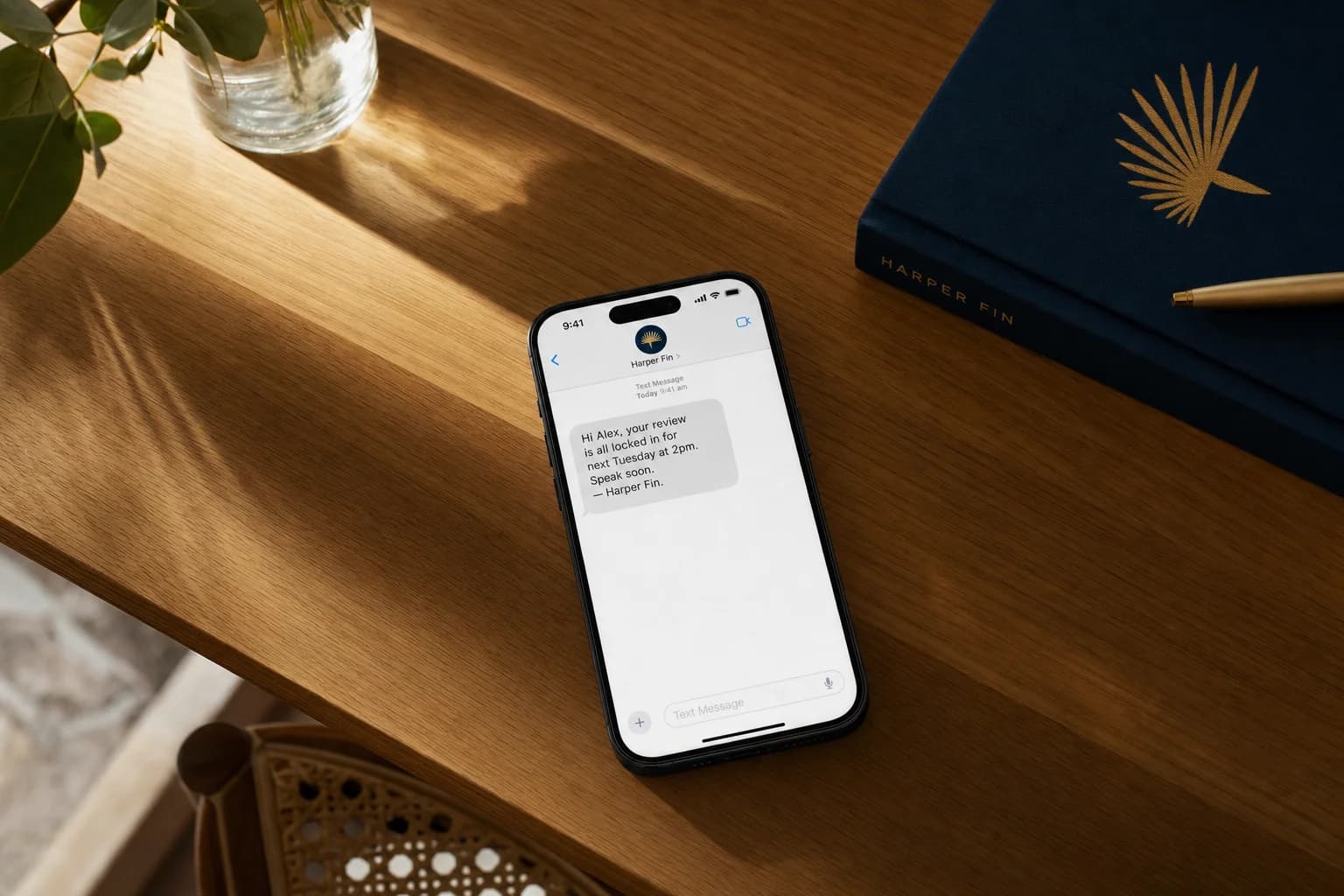
- A phone system that answers calls, books appointments, and captures lead details when you're on a job or with a client
- A chatbot on your website that responds to enquiries at 2am instead of letting them bounce
- Automated review requests that go out after every job, without anyone remembering to send them
- Smart scheduling that fills gaps, sends reminders, and reduces no-shows
None of this is mysterious. It's automation with a layer of intelligence, the software can understand context, respond naturally, and make basic decisions rather than just following rigid "if this, then that" rules.
The confusion happens because the term "AI" gets slapped on everything from a simple email template to a $50,000 enterprise platform. For small business purposes, the AI that matters is the kind that quietly handles the work you keep meaning to get to but never do.
Where does AI deliver real ROI for small businesses?
This is where the honest conversation starts. Some AI applications deliver measurable, undeniable value for Australian service businesses. Here are the ones we see working consistently:
AI phone answering
This is the single highest-ROI use of AI for most service businesses. Calls can go unanswered when you're with a customer, on the tools or closed for the day, and a caller who can't get through can simply ring your competitor instead. An AI phone answering service picks up every call, captures the enquiry, books the appointment or takes a message, and costs a fraction of a receptionist.
Typical saving: $2,000-$6,000/month in recovered revenue from calls that would otherwise be missed.
AI chatbots
A well-built AI chatbot on your website converts visitors into leads around the clock. For service businesses, most website visits happen outside business hours, evenings and weekends. Without a chatbot, those visitors read your page, maybe look at your number, and leave. With one, they get an instant response and can book on the spot.
Typical saving: more website visitors turned into enquiries, because they get an instant response instead of leaving.
Review automation
Getting Google reviews is one of the most effective marketing activities for local businesses, but almost nobody does it consistently because it's tedious. AI-powered review automation sends a personalised request after every job, follows up if needed, and can even help you respond to reviews. Businesses that automate this ask every customer, instead of only the ones they remember.
Typical saving: Equivalent to $500-$1,500/month in marketing value, plus compounding long-term SEO benefit.
Appointment reminders and no-show reduction
Automated appointment reminders and booking with smart timing reduce no-shows. Say you run 150 appointments a month at an average of $180: every 10 no-shows avoided is $1,800 in recovered revenue.
Where is AI overhyped for small business?
Here's where I'll probably lose a few people in my industry, but it needs to be said. Not everything branded as "AI" is worth your money.
AI content generation replacing humans
Tools like ChatGPT are useful for brainstorming, drafting, and research. But if you're paying an agency that's just feeding prompts into an AI and handing you the output as "content marketing," you're overpaying for mediocre work. Google's algorithms are increasingly good at detecting and devaluing generic AI content. Your customers can tell the difference too. AI-assisted content with genuine human expertise? Great. Fully AI-generated content pretending to be thought leadership? Not worth it.
"AI strategy consultants"
A cottage industry has popped up selling AI strategy sessions and roadmaps to small businesses. Most of these are generic frameworks dressed up in buzzwords. If someone's charging you $5,000 for an "AI transformation strategy" and your business does $500K in revenue, walk away. You don't need a strategy document, you need two or three specific automations that solve real problems.
Tools that need constant babysitting
Some AI products are technically impressive but practically useless because they require constant tweaking, prompt engineering, or manual oversight to work properly. If an AI tool creates more admin work than it removes, it's not automation, it's a hobby project. The whole point is to free up your time, not consume more of it.
All-in-one AI platforms you'll never fully use
Plenty of platforms offer 50 AI features for $299/month. Most small businesses end up using three of them. You'd be better off with targeted tools that do specific jobs well rather than paying for a Swiss Army knife when you only need a screwdriver.
How much does small business AI cost in Australia?
Cost depends on what you automate and how much is built and managed for you, so the useful comparison is where each tool saves time:
| AI Tool Type | Typical Time Saved | ROI Timeline |
|---|---|---|
| AI phone answering | 15-25 hrs/month | 2-4 weeks |
| AI website chatbot | 10-15 hrs/month | 3-6 weeks |
| Review automation | 5-10 hrs/month | 4-8 weeks |
| Appointment reminders/scheduling | 8-12 hrs/month | 1-2 weeks |
| Lead nurture sequences | 10-20 hrs/month | 4-8 weeks |
| Comprehensive done-for-you package | 40-80 hrs/month | 2-6 weeks |
Get quotes for your own volume and tasks before comparing providers. Enterprise tools like Salesforce Einstein or HubSpot's AI features can cost significantly more, but most service businesses don't need, and won't benefit from, that level of infrastructure.
A comprehensive done-for-you business automation package from a provider like LUNA Systems typically includes multiple tools working together, plus ongoing management and optimisation. That's where the 40-80 hours of saved time comes from, it's not one tool, it's an integrated system.
How do you evaluate if AI is worth it for YOUR business?
Before you spend anything, run through this three-step framework:
Step 1: Identify your biggest time sinks
Write down every task in your business that's repetitive, manual, and doesn't require senior-level decision-making. Common ones include:
- Answering the phone and taking messages
- Responding to website enquiries
- Sending appointment reminders
- Chasing reviews
- Following up on quotes
- Sending rebooking reminders to past clients
Step 2: Calculate what those tasks actually cost
Be honest here. If you're personally spending 10 hours a week on admin tasks and your time is worth $80/hour as a business owner, that's $3,200/month in opportunity cost, time you could spend on billable work, business development, or just not working weekends.
If a staff member handles it, calculate their loaded cost (wages plus super plus leave plus overheads). A part-time admin doing 20 hours a week costs roughly $2,500-$3,500/month fully loaded.
Step 3: Compare to the solution cost
Now compare that figure with the quotes you get for automating those tasks. If the monthly cost is a small fraction of the time and missed revenue it replaces, the decision is straightforward.
If the numbers are marginal, and the saving is only a little more than the monthly cost, it might still be worth it for consistency and reliability, but it's a closer call. Be honest with yourself about whether the switch makes sense right now.
What have I stopped recommending, and what did I try that failed?
I've been on both ends of this. Two things I no longer recommend to small businesses: "AI strategy" generic chat tools as a productivity layer (owners try it for a fortnight then forget about it), and AI-written email newsletters as a top-of-funnel play (deliverability tanks, unsubscribe rates spike, and the only person reading the email is the owner).
What doesn't work: pushing AI into customer-facing copy too early. Website copy written end to end by AI with no human pass reads as generic, and visitors notice. Use AI as the drafter and a human as the editor.
The honest rule I follow now: AI replaces repetitive operational work (phone, reminders, reviews, follow-up). It does not replace voice, sales judgement, or first-time customer trust. Buy AI for the back office. Keep the front of house human. Your website counts as front of house, so on the small business websites we build the same rule applies: AI can draft, a person edits.
Frequently asked questions
Is AI too expensive for a small business?
Not if you choose the right tools. Start with the one automation that fixes your biggest time sink or revenue leak, get it quoted for your real volume, and compare that with what the problem costs you now. The question isn't whether you can afford AI, it's whether you can afford to keep doing everything manually.
Will AI replace my staff?
For most small businesses, no. AI handles the repetitive tasks that your staff either don't have time for or shouldn't be spending their time on. It's more likely to make your existing team more productive than to replace them. The exception is if you're paying someone purely to answer phones and send appointment reminders, that role can often be largely automated.
What's the biggest mistake small businesses make with AI?
Buying a broad platform before identifying specific problems. Start with your single biggest time sink or revenue leak, automate that, measure the results, then expand. Businesses that try to automate everything at once usually end up with a mess of half-configured tools that nobody maintains.
How long does it take to set up AI automation?
Individual tools can be live within a few days. A comprehensive automation system, covering phone answering, chatbot, reviews, reminders, and lead nurture, typically takes two to four weeks to build, test, and launch. Done-for-you providers like LUNA Systems handle the entire setup process so you don't need to become a tech expert.
So, is AI actually worth it for small business?
AI is worth it for small business in Australia, when it's applied to the right problems. The businesses getting the best results aren't the ones chasing every new AI trend. They're the ones who identified a specific, measurable problem (missed calls, no-shows, slow follow-up) and deployed a targeted solution.
If you're an Australian service business losing revenue to missed calls, slow response times, or inconsistent follow-up, AI automation is worth pricing up against your own numbers, using the sums above. If you're looking for a magic button that replaces thinking and decision-making, you'll be disappointed.
We build done-for-you automation systems for Australian service businesses. No lock-in contracts, no buzzword strategies, just practical tools that save you time and recover lost revenue. Book a discovery call and we'll tell you honestly whether automation makes sense for your business right now.
More frequently asked questions
Is AI worth it for a small business in Australia?
It depends entirely on what you use it for. AI that handles repetitive, clearly defined work like answering after-hours calls, sending review requests, or managing appointment reminders is where the return is easiest to measure. Where it falls short is the flashier promises: fully automated content, AI strategy consulting, or tools claiming to replace your whole admin team. Buy AI for the back office and keep the front of house human.
Which AI tools deliver the best ROI for a service business?
AI phone answering is the single highest-ROI use for most service businesses, because a call that rings out while you're busy can be an enquiry that goes straight to a competitor. Website chatbots catch enquiries that would otherwise leave, review automation makes asking for a review happen after every job, and automated reminders cut no-shows.

Founder, LUNA Systems · Registered Nurse (AHPRA: NMW0002113429)
Former nurse and beauty therapist turned automation consultant. Justine builds custom AI systems for Australian service businesses, so they can stop chasing leads and start growing.
Want automation tips in your inbox?
Get weekly insights on business automation. No spam, unsubscribe anytime.