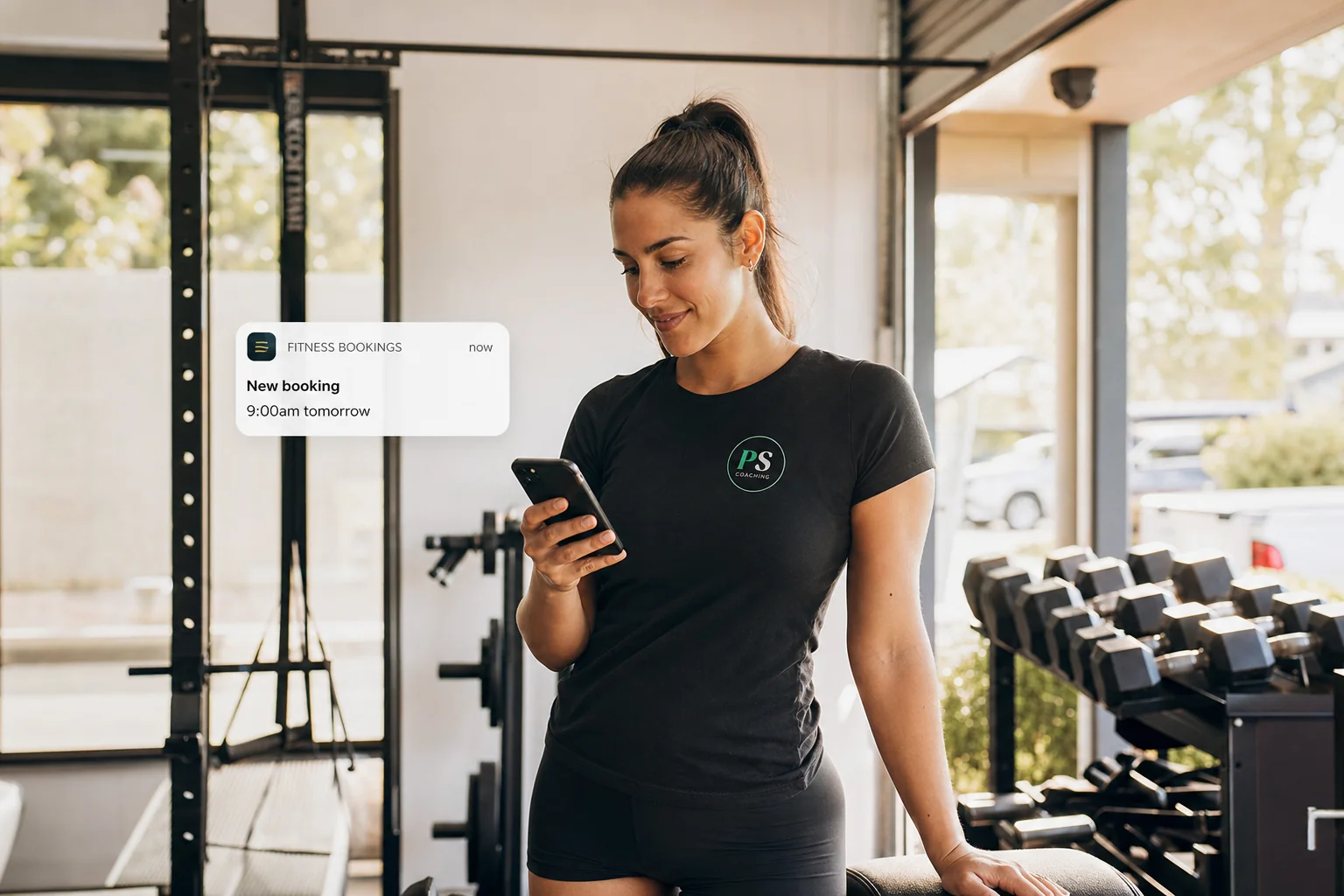
A good personal trainer website answers three things in the first five seconds: who you help, what makes you different, and how to book. It needs one obvious booking button above the fold, real client results (not stock photos), and a load time under three seconds, because most people will be looking at it on their phone between sets at someone else's gym.
In short: Most PT websites are digital business cards nobody reads. A booking-first site with real results, fast mobile load, and a Google Business Profile behind it turns browsers into booked sessions instead of bounces. Treat the cost as a lead-generation spend, not decoration.
What actually makes a good personal trainer website
Forget "professional" and "modern". Those words don't book sessions. A personal trainer website works when it does three specific jobs: proves you're legitimate, proves you get results, and makes booking effortless.
Proof of legitimacy is your certifications, your specialisation, and a face people recognise. Proof of results is real clients, named with their permission, and specific outcomes. A line like "ran my first 10 km after 12 weeks" beats "great trainer, highly recommend" every time. And effortless booking means the calendar link is visible without scrolling, not buried three menu clicks deep.
Here's the uncomfortable truth: your site is doing reputation work whether you've thought about it or not. A cluttered layout, a stock photo of someone else's gym, and a contact form from 2015 tells a stranger you're not serious, even if you're brilliant in the room.
The five things every PT site needs (and most skip)
Most personal trainer websites we've seen fall into one of two traps: they're a glorified business card with a phone number, or they're trying to be everything (blog, shop, member portal, forum) before they've nailed the basics. Strip it back to five things:
- A specific, above-the-fold statement of who you help. Not "personal trainer in Brisbane", but "strength coaching for busy parents who've got 45 minutes, three times a week". Specificity reads as expertise.
- A booking button visitors can't miss. Not a "contact us" form buried under an About page. A calendar link, live and clickable, in the first screen someone sees. Every extra step between interest and booking costs you clients.
- Real results, real names. Testimonials with a first name, a photo (with permission), and a number, kilos, weeks, PBs, beat five-star ratings with no context. This is where website design for lead generation earns its keep: proof placed right next to the ask.
- Fast mobile load. People on their phones will not wait around for a slow page. If your gallery of gym photos is dragging load times past four seconds, you're losing people before they've read a word.
- A Google Business Profile that actually links back. Most people don't type your business name into Google, they type "PT near me" or "suburb] personal trainer". Without a [Google Business Profile connected to your site, you're invisible to that search entirely.
Miss any one of these and you're not really running a lead-generation site, you're running an online noticeboard.
Common mistakes we see in personal trainer websites
The mistakes are rarely about taste. They're structural.
Booking buried behind a contact form. A generic "get in touch" form that emails you, which you then have to reply to, which the client then has to check, before anyone lands on a calendar, adds three extra steps to what should be one click. Each additional step in a booking flow measurably reduces conversion.
No mobile testing. The site looks great on the designer's laptop and breaks on a phone screen, which is where most fitness website visitors actually are. If your hero image cuts off a call-to-action on a 6-inch screen, you've built for the wrong device.
Stock photography instead of your actual gym, your actual clients, your actual face. People are booking a relationship, not a franchise. A stranger in a stock photo undoes the trust your results are trying to build.
No local signal at all. A beautifully designed site that never mentions a suburb, doesn't connect to a Google Business Profile, and isn't built around local search terms is invisible to the exact people searching for a trainer nearby right now.
Copy that reads like it was written by nobody in particular. Generic "passionate about helping you achieve your goals" copy is everywhere, and everyone can tell. The sites that convert in 2026 read like an actual person wrote them, because they did.
This is the same pattern we cover in our niche website builds for tradies, just swapping tradie-specific proof points for fitness-specific ones. The mechanics of what makes a visitor act are identical across service businesses.
DIY vs done-for-you: what's the real trade-off
DIY builders like the templated platforms will get you a live site on a yearly subscription, and if you're handy and have a free weekend, that might be enough to start. The honest catch: you're trading your own hours, the ones you'd otherwise spend coaching or marketing to actual leads, for a site that usually looks like every other DIY fitness template, because you're all pulling from the same block library.
A done-for-you build costs more upfront and is quoted per project: a focused single-trainer site is a smaller job than one with booking automation, review collection, and proper local SEO baked in. What you're buying isn't just design, it's someone who has already made the mistakes above and fixed them on other sites.
If you're self-employed and setting your own rates, note that the Fair Work Ombudsman's Fitness Industry Award sets minimum casual rates at $32.18 an hour from 1 July 2026, while genuinely self-employed trainers typically charge $50 to $110-plus an hour. The gap between those numbers is largely brand, positioning, and trust, and your website is doing a lot of that work before a client ever picks up the phone.
What it costs to build a personal trainer website
Here's how each option is priced, because "it depends" isn't an answer.
- DIY template: a yearly subscription. Your time cost is the real price tag.
- Freelancer, basic build: usually a one-off price. Fine for a simple one-page site, thinner on strategy and testing.
- Done-for-you, focused build: quoted per project. A proper single-trainer or small-studio site with booking, testimonials, and basic local SEO.
- Done-for-you, full build: quoted per project. Adds booking automation that syncs with your calendar app, review automation that keeps testimonials flowing without you having to chase them, and SEO built in from day one rather than bolted on later.
Ongoing costs include monthly hosting, plus a separately quoted maintenance plan if you want someone else maintaining and updating the site rather than doing that yourself between clients.
The honest business case: a website that generates even one extra client a month at $70 a session, weekly, keeps paying for itself once the build cost is recovered. Compare that to boosting a single Instagram post for a weekend and watching the reach evaporate the moment you stop paying.
Instagram is not a substitute for a website
We hear this a lot: "I've got 4,000 followers, why do I need a website?" Because Instagram is rented land. The algorithm decides who sees your posts, a bio link only fits five options before it becomes a maze, and none of it shows up when someone searches "personal trainer [suburb]" on Google.
A website is the one asset you fully own. It works at 2am while you're asleep. It ranks locally for people who've never heard of your Instagram handle. And it converts a stranger into a booking without needing them to already be a follower.
That's not an argument against Instagram, keep posting, it builds trust fast and costs nothing but time. It's an argument for running both: Instagram for reach and personality, a website for the actual booking. According to the Australian Bureau of Statistics, 51% of Australian businesses now used social media for their online presence in 2024-25, up from 47% in 2021-22, but relying on social alone still leaves you locked out of local search, which is where most booking-ready searches happen.
How to choose someone to build it
If you're going the done-for-you route, ask three questions before you sign anything:
- Can you show me a fitness or service-business site you've built, and can I see how fast it loads on a phone right now? If they can't answer that live, that's the answer.
- Is booking integration included, or is that an extra? A site with no calendar sync is a brochure, not a lead generator.
- What happens to my local search visibility? If Google Business Profile setup and basic on-page SEO for your suburb aren't part of the build, you're paying for a website nobody local will find.
A trainer's website should do the same job as a well-run session: get straight to the point, prove it works, and make the next step obvious.
Frequently asked questions
How much does a personal trainer website cost in Australia?
DIY builders are a yearly subscription but eat your time instead of your budget, and a freelancer building a basic site usually quotes a one-off price. A done-for-you build, from a focused single-trainer site to a fuller one with booking integration, testimonials, and SEO basics done properly, is quoted per project after a discovery call.
Do I need a website if I already have Instagram?
Instagram builds trust fast, but it's rented land: the algorithm decides who sees you, and a bio link with five options isn't a booking system. A website is the one thing you own that works while you're training clients and ranks on Google for people who aren't already following you.
What should a personal trainer website include?
At minimum: a clear statement of who you help, an obvious booking button above the fold, real client results with names and specifics, your pricing or a clear next step, and a Google Business Profile linked in so local searches find you.
Should I build my own website or hire someone?
DIY can get you a passable site for very little cash if you're comfortable with a builder and have a spare weekend. But most trainers underestimate the time cost and end up with a site indistinguishable from every other DIY fitness site.
How long does it take to build a personal trainer website?
A straightforward site with booking integration typically takes one to three weeks from brief to launch, depending on how fast you supply photos, testimonials, and copy decisions.
Does a personal trainer really need to rank on Google, or is local enough?
For most PTs, local is the whole game. People search "[suburb] personal trainer" when they're ready to book. A Google Business Profile plus a site built around your suburb and speciality does more for booked sessions than chasing keywords you'll never rank for.
Want a site that actually books clients?
You don't need a bigger Instagram following. You need a website that turns the people already searching for a trainer near you into booked sessions, fast to load, easy to book, built around real results instead of stock photos.
Book a free strategy call and we'll look at what's stopping your current site (or lack of one) from converting, then tell you honestly what it'd take to fix it.

Founder, LUNA Systems · Registered Nurse (AHPRA: NMW0002113429)
Former nurse and beauty therapist turned automation consultant. Justine builds custom AI systems for Australian service businesses, so they can stop chasing leads and start growing.
Want automation tips in your inbox?
Get weekly insights on business automation. No spam, unsubscribe anytime.